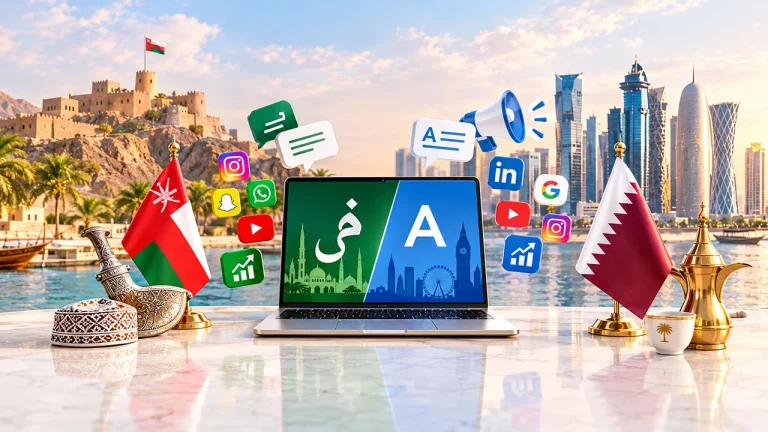

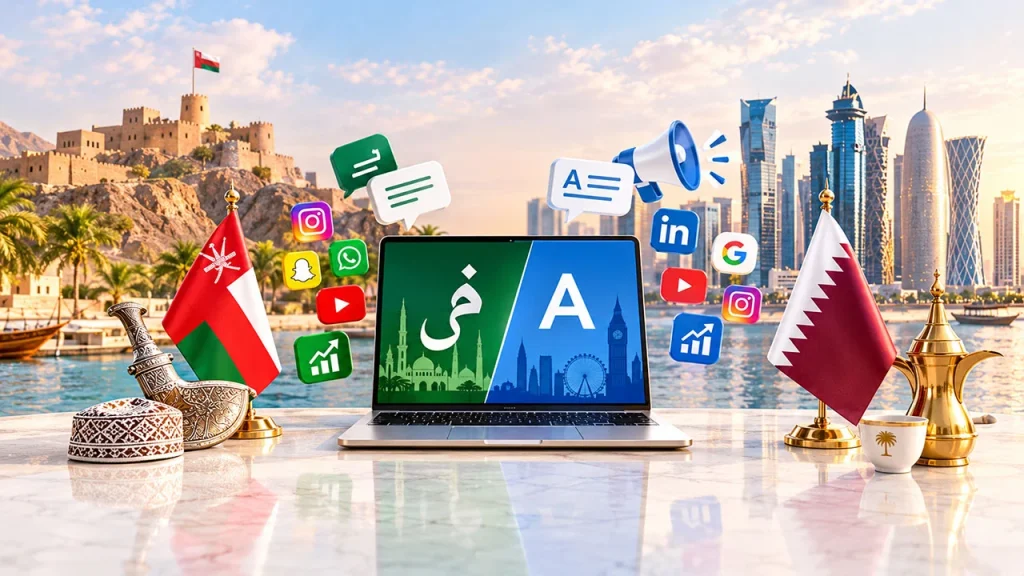
Choosing between Arabic and English marketing in Oman and Qatar is not simply a translation decision. It affects how customers discover your business, understand your offer, compare providers, and decide whether to contact you.
An English website may work well for an international consultancy targeting corporate clients in Doha. An Arabic campaign may be more suitable for a local home services company in Muscat. A property developer, healthcare provider, or retail brand may need both languages to reach different customer groups at different stages of the buying journey.
The right approach to Arabic vs English marketing Gulf businesses use depends on the audience, service, channel, and commercial goal. Neither language automatically produces better results. What matters is whether your message matches the people you want to reach.
This guide compares Arabic and English marketing in Oman and Qatar, explains the SEO implications of a bilingual website, and shows how to choose a practical language strategy without doubling your workload unnecessarily.
Understanding Language Preferences in Oman and Qatar
Arabic is the official language in both countries, while English is also widely used. Qatar’s Government Communications Office confirms that Arabic is the official language and English is widely used as a second language. Oman’s official information similarly identifies Arabic as the official language, with widespread use of English.
For businesses, the practical lesson is not that every customer prefers one language. It is that both languages can serve different audiences and purposes.
Oman: local trust and international business
In Oman, Arabic is a natural starting point for many campaigns aimed at Omani consumers and local communities. Businesses selling home maintenance, family services, local retail, or consumer products should consider how Arabic content can make their offer more accessible and familiar.
English also has a meaningful role in Oman’s business environment, particularly when companies work with international clients, expatriate professionals, or regional partners. A B2B consultancy in Muscat, for example, may need English service pages for international decision-makers while using Arabic campaigns to reach local business owners.
A well-planned bilingual marketing Oman strategy does not require every message to be translated word for word. It requires a clear understanding of which audience each campaign is intended to reach.
Qatar: a diverse audience with different search habits
Qatar’s business environment includes local consumers, international professionals, expatriate communities, and companies operating across borders. English can be useful for reaching international audiences and presenting complex B2B services. Arabic remains essential to consider when a business wants to communicate effectively with Arabic-speaking customers.
Imagine a dental clinic in Doha. An English page may explain insurance arrangements, specialist treatments, and appointment options to international residents. An Arabic page can address the same service for Arabic-speaking patients using language and terminology that feel natural to them.
The two pages should communicate the same core facts, but the wording, examples, and frequently asked questions may need to differ.
Do not treat Oman and Qatar as one identical market. Start with country-specific customer research, then refine the strategy by industry, audience, and location.
Arabic vs English marketing Gulf: Advantages and Limitations

Both languages can support customer acquisition. The difference lies in how well each one fits the audience and the message.
| Factor | Arabic marketing | English marketing |
|---|---|---|
| Local audience | Can make communication more accessible for Arabic-speaking customers | May exclude customers who are less comfortable using English |
| International reach | Useful for Arabic-speaking audiences across the region | Useful for international professionals and cross-border B2B communication |
| Trust and familiarity | Natural phrasing can create a stronger sense of cultural and local relevance | Clear professional English can support credibility with international buyers |
| SEO opportunities | Helps target relevant Arabic search queries and user needs | Supports English-language searches and industry terminology |
| Content production | Requires strong Arabic writing and appropriate terminology | Requires fluent, audience-aware English rather than literal translation |
| Maintenance | Needs Arabic editing, right-to-left layout checks, and language-specific updates | Needs its own editorial review, updates, and conversion testing |
Where Arabic marketing can be stronger
Arabic can help a brand communicate in the language customers use to describe everyday needs, compare local providers, and ask questions before making a purchase.
For example, a plumbing company serving residential customers in Muscat could publish Arabic pages explaining emergency repairs, service availability, and how to request a quote. Those pages may address concerns that a short English landing page does not cover.
Arabic advertising can also make promotions, service explanations, and customer support more accessible to people who prefer Arabic. However, quality matters. Awkward translations, inconsistent terminology, or overly formal wording can make a campaign feel disconnected from its audience.
Modern Standard Arabic may be appropriate for many formal website pages, while advertising and social content may benefit from a more conversational tone. The right choice depends on the brand, channel, and intended audience.
Where English marketing can be stronger
English is useful when your target customers include international companies, expatriate professionals, or buyers who use English-language industry terminology.
A marketing agency in Doha targeting multinational businesses, for instance, may need English pages about performance marketing, CRM integration, analytics, and lead generation. The audience may evaluate the provider based on service scope, reporting methods, case studies, and commercial outcomes.
English can also help a company maintain a consistent message across international campaigns. But a polished English website is not automatically enough for a Gulf market. If Arabic-speaking prospects are a significant part of the target audience, ignoring Arabic may leave valuable demand unaddressed.
The risk of choosing only one language
An Arabic-only strategy can limit access to customers who search and evaluate providers in English. An English-only strategy can make a business less accessible to Arabic-speaking audiences.
That does not mean every business needs two complete websites immediately. A small company may get better results by translating its highest-value service pages and contact information first, then expanding after measuring demand.
How Language Choice Affects SEO in the Gulf
If your customers search in both Arabic and English, your website should help search engines understand which page serves each audience. Publishing two languages is not just a matter of copying text into a translation plugin.
A strong multilingual SEO Gulf strategy connects language, search intent, page structure, and local relevance.
Research keywords separately in each language
People do not always search for a service using the same wording in Arabic and English. Direct translations can miss the phrases customers actually use.
Consider a business offering air conditioning maintenance in Oman. English research might identify searches such as “AC maintenance Muscat” or “air conditioning repair Oman.” Arabic research should investigate how local users phrase equivalent service requests rather than simply translating those terms literally.
Use keyword research tools, Google Search Console data, customer enquiries, and search suggestions to identify relevant phrases. Group them by intent: someone looking for a definition needs different content from someone ready to request a quote.
For Qatar, a company providing commercial cleaning could build separate English and Arabic keyword groups around office cleaning, contract cleaning, and service enquiries. Each group should guide the content of the relevant page.
Create dedicated URLs for each language
Google recommends using different URLs for different language versions and using hreflang annotations to help it understand which versions are intended for which audiences. It also advises against automatically redirecting users based on an assumed language preference, since this can make pages harder for users and search engines to access. See Google’s multilingual and multi-regional website guidance.
A simple structure could look like this:
| Page purpose | English URL example | Arabic URL example |
|---|---|---|
| Main website | example.com/en/ | example.com/ar/ |
| Oman service page | example.com/en/oman/seo-services/ | example.com/ar/oman/seo-services/ |
| Qatar service page | example.com/en/qatar/marketing/ | example.com/ar/qatar/marketing/ |
These are illustrative URLs, not recommendations to create every possible page. Your actual structure should reflect the services and markets you genuinely serve.
Each language version should have translated navigation, headings, metadata, calls to action, and useful main content. Add appropriate hreflang annotations, ensure the language versions reference one another correctly, and give users a visible language switcher.
Avoid relying on a single URL that changes language through a cookie or browser setting. Google may not discover every version as reliably as it can discover separate, crawlable URLs.
Avoid thin translations and duplicate local pages
A translated page should be useful on its own. If an English page describes a service in detail but the Arabic version contains only a short summary, Arabic-speaking visitors may not receive enough information to make a decision.
Localization can go beyond translation. An Arabic page might need different examples, terminology, FAQs, or explanations of the booking process. An English page aimed at corporate buyers may need more detailed service specifications and reporting information.
Country targeting also deserves attention. An Oman page and a Qatar page should not be identical copies with only the country name changed. Include accurate service coverage, relevant contact information, appropriate local examples, and any genuine differences in availability.
Remember that language and country are not interchangeable. An Arabic page can serve users in more than one country, while an English page can target a particular market. Use content and technical signals to make the intended audience clear.
How to Choose a Language Strategy by Business Type

The best approach depends on how customers discover your business and what they need before buying. Use these recommendations as starting points, then validate them against your own search and sales data.
Local service businesses
Examples: cleaning companies, plumbers, electricians, salons, and home maintenance providers.
For these businesses, Arabic deserves serious consideration when targeting local residential customers. People often want to understand the service, availability, price factors, and contact process before requesting help.
In Oman, a home maintenance business could start with Arabic and English versions of its core service pages, supported by clear service-area information and an easy enquiry process. In Qatar, a similar company could assess demand across its actual coverage areas before investing in additional landing pages.
Recommended approach: prioritize the language customers use most often, then add the second language to high-intent service pages and contact flows when evidence supports it.
B2B and professional services
Examples: marketing agencies, IT consultancies, business consultants, and corporate training providers.
English may be a practical starting point for companies targeting international businesses and professionals who evaluate providers through English-language service descriptions, proposals, and case studies.
However, local decision-makers may prefer Arabic for initial communication or particular types of services. A company that depends on relationships with local businesses should test whether Arabic landing pages, brochures, and follow-up materials improve engagement.
Recommended approach: maintain strong English service pages and create Arabic versions for services where local demand, sales conversations, or search data justify the investment.
Real estate and property services
Property businesses often need to communicate with several buyer groups. A developer in Doha may serve local families, international residents, investors, and overseas buyers. An agency in Muscat may address local property seekers as well as people considering relocation or investment.
A single generic page may struggle to answer all these audiences’ questions. Arabic content can address local buyer concerns, while English pages can explain property features, enquiry procedures, and relevant information for international prospects.
Recommended approach: localize high-value property pages and enquiry forms. Keep property details accurate and ensure both versions reflect the same current availability and terms.
Retail, restaurants, and hospitality
For restaurants, cafés, retail shops, and hospitality businesses, language affects more than search rankings. It influences whether customers can understand a menu, compare products, check opening hours, or make a reservation.
A restaurant in Muscat might use Arabic for local promotions and English to reach international residents and visitors. A retailer in Doha could provide bilingual product information and customer support while adapting social campaigns to the audience on each platform.
Recommended approach: prioritize bilingual customer-facing information, including menus, product details, opening hours, booking instructions, and customer support. Use separate campaign versions when the offer or audience differs.
A practical decision matrix
| Your business situation | Suggested starting point |
|---|---|
| Mainly local residential customers | Test Arabic-first communication with essential English coverage |
| International B2B clients | English-first, with Arabic where it supports local acquisition |
| Mixed local and expatriate audience | Build bilingual core pages and track performance by language |
| Limited budget or small team | Start with the highest-value pages in both languages |
| Multiple Gulf markets | Research each country’s language demand and localize pages by market |
These are starting recommendations, not fixed rules. Search behaviour, conversion data, and actual customer conversations should guide your next investment.
Build a Bilingual Content Plan Without Doubling Your Workload
A bilingual strategy can become expensive if every blog post, social update, and landing page is translated automatically. Start with the content that is most likely to influence a buying decision.
A practical rollout has four stages:
Stage 1: Audit current performance. Review your website’s language versions, search queries, traffic, enquiry quality, and existing conversion rates. If you have no Arabic content, identify the services most likely to benefit from it.
Stage 2: Prioritize commercial pages. Translate and localize your main service pages, contact page, essential FAQs, and high-intent landing pages first. Make sure the translated content includes the same important information as the original.
Stage 3: Expand based on demand. Use keyword research and customer questions to decide which blog posts, guides, and supporting pages should be created in the second language. You do not need to publish every article twice.
Stage 4: Measure and refine. Compare organic clicks, qualified enquiries, conversion rates, and engagement by language. If Arabic pages attract visitors but few enquiries, review the content, offer, and contact process before publishing more pages.
If your team needs specialist support, multilingual content services can help with keyword research, localization, content planning, and maintaining a consistent brand voice across language versions.
Frequently Asked Questions
Is Arabic or English better for marketing in Oman?
Neither is universally better. Arabic can be valuable for reaching Arabic-speaking local customers, while English can support international business and audiences who prefer it. The right mix depends on your industry and customer research.
Should businesses in Qatar have an Arabic and English website?
A bilingual website is worth considering if both language groups are commercially relevant. Start with core service pages and contact information, then expand based on search demand and conversion data.
Does translating a website improve SEO automatically?
No. Translation alone does not guarantee better rankings. Each version needs useful content, appropriate keyword research, crawlable URLs, correct language signals, and a good user experience.
Do I need separate Arabic and English social media accounts?
Not necessarily. One account may be manageable for a small business, while separate accounts can help brands with distinct audiences and substantial content resources. Choose a structure your team can maintain consistently.
How can I measure which language generates more customers?
Use Google Analytics, Google Search Console, lead tracking, and your CRM where available. Compare qualified enquiries and sales by landing-page language, not just page views or social engagement.
Conclusion: Choose the Language Your Customers Trust
The choice between Arabic and English marketing in Oman and Qatar should come from customer needs, search behaviour, and commercial goals, not assumptions. Arabic can strengthen access to local audiences, while English can support international reach and professional communication. For many businesses, a carefully planned combination offers the most flexibility.
Start with the pages closest to a sale, make each language version genuinely useful, and measure which one brings qualified leads. If you want to turn that analysis into a practical plan, Plan Your Bilingual Content Strategy with Robin Advertising and build a language strategy around your target customers, budget, and growth priorities.